I'm currently a Marie Curie fellow in the Galaxies and Cosmology Group in the Lagrange Lab at Observatoire de la Côte d’Azur (OCA).
Previously I was a postdoc in the Dynamics Group at Max-Planck-Institut für extraterrestrische Physik (MPE) working with Ortwin Gerhard.
My thesis research on The Dynamics of White Dwarfs, Black Holes and Stellar Cusps [pdf] was performed at Caltech where my advisor was Sterl Phinney.
Mapping the Three-Dimensional Density of the Galactic Bulge with VVV Red Clump Stars
Authors: Chris Wegg and Ortwin Gerhard
Using red clump giant stars identified in the VVV survey we produced the most accurate and high resolution map of the inner regions of the Milky Way. Our density map covers the inner (2.2x1.4x1.1)kpc of the bulge/bar. Line-of-sight density distributions were estimated by deconvolving extinction and completeness corrected K-band magnitude distributions. In constructing our measurement, we assumed that the three-dimensional bulge is 8-fold mirror triaxially symmetric, but the map is otherwise completely non-parametric. In doing so we measure the angle of the bar-bulge to the line-of-sight to be (27+- 2)deg, where the dominant error is systematic arising from the details of the deconvolution process. Our density distribution shows a highly elongated bar with projected axis ratios ~(1:2.1) for isophotes reaching ~2kpc along the major axis. Along the bar axes the density falls off roughly exponentially, with axis ratios (10:6.3:2.6) and exponential scale-lengths (0.70:0.44:0.18)kpc. From about 400pc above the Galactic plane, the bulge density distribution displays a prominent X-structure. Overall, the density distribution of the Galactic bulge is characteristic for a strongly boxy/peanut shaped bulge within a barred galaxy.
Using Multiple Tidal Disruptions to Find Close Supermassive Black Hole Binaries
Authors: Chris Wegg and Nate Bode
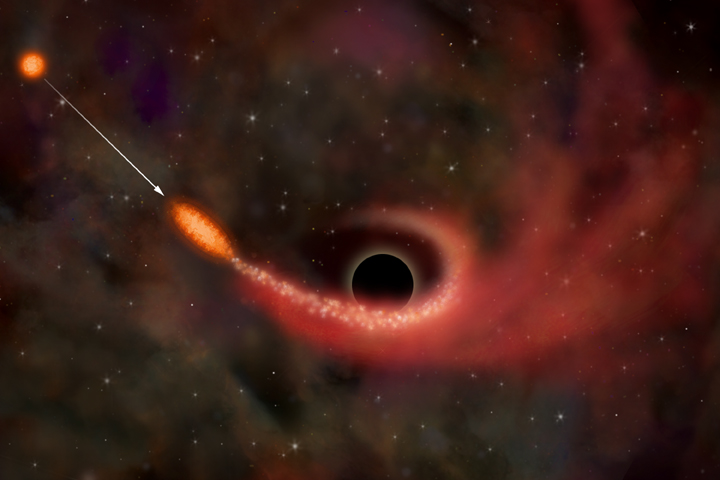 Image Credit: NASA/CXC/M.Weiss
Tidal disruptions occur when a star wanders close to the central supermassive blackhole in a galaxy and is torn apart by tidal forces. This produces a flare as the resultant gas falls back and accretes onto the blackhole. While the canonical disruption rate is 10 −5per year, it had been suggested that the tidal disruption rate from binary SMBHs could be as high as 1 per year. In collaboration with Nate Bode we simulated the dynamics of stars around binary SMBH blackholes. We wrote a symplectic integrator from scratch to include two previously important but unmodeled effects: the potential of the stellar cusp, and the binary SMBH inspiral. We showed that if a galaxy hosting multiple tidal disruptions is observed, it almost certainly contains a closely separated binary SMBH due to the greatly enhanced tidal disruption rate. This provides a novel method to identify < 1 pc binaries, which are predicted to be ubiquitous but currently have remarkably scant evidence for their existence.
Poster from the 2011 Michigan SMBH Workshop:
Production of EMRIs in Supermassive Black Hole Binaries
Submitted to MNRAS
Authors: Nate Bode and Chris Wegg
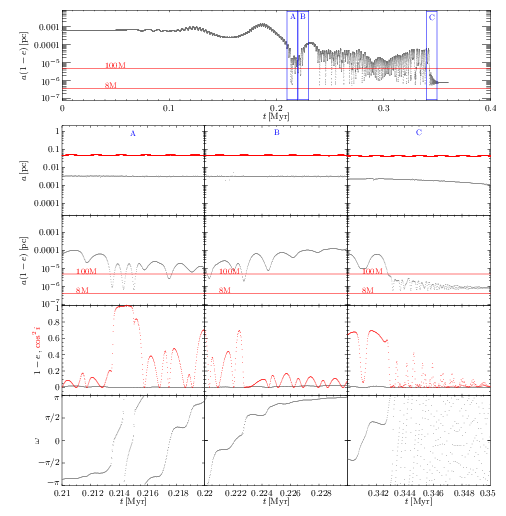
Extreme mass ratio inspirals (EMRIs) occur when stellar-mass compact remnants inspiral though the emission of gravitation radiation into a SMBH. They are one of the primary sources of interest for low-frequency gravitational wave detectors such as LISA (or LISA-like missions). During our work on the enhanced tidal disruption from SMBH binaries, we realized that the rate of EMRI production is also likely to be enhanced. To investigate this we added relativistic corrections to the code written to calculate tidal disruption rates. Our results show that during each major merger containing a 10 6M⊙ blackhole 10-20 EMRIs are produced. These EMRIs could be of special interest to LISA-like missions since the presence of the secondary SMBH could potentially be detected in the EMRI waveform, extending the range of SMBH binary separations which can be investigated by LISA to ~0.1pc
Poster from the 2011 Michigan SMBH Workshop:
Pseudo-Newtonian Potentials for Nearly Parabolic Orbits
Authors: Chris Wegg
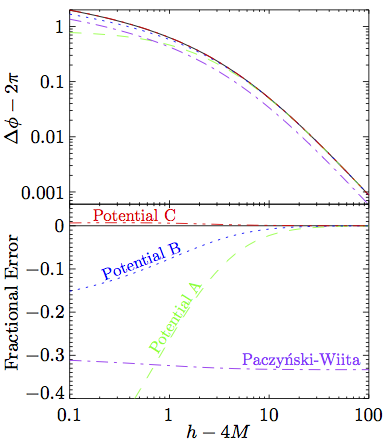
For the work on EMRIs from SMBH binaries we needed a potential energy function that would reproduce the GR precession. It needed to be a function of radius only, so that we could use a symplectic integrator constructed from operator splitting methods that was accurate over the required very long periods. I realized that the commonly used Paczynski-Wiita potential gives the incorrect precession for the nearly parabolic orbits we were interested in, and so derived potentials useful for this regime. They should be useful elsewhere however, since they produce the correct precession whenever the particles apoapse lies in the far field. They're much simplier to implement and computationaly efficient than the 2.0PN expressions. They also correctly diverge for Schwarzchild holes.
White Dwarf Kinematics vs. Mass
Authors: Chris Wegg and Sterl Phinney
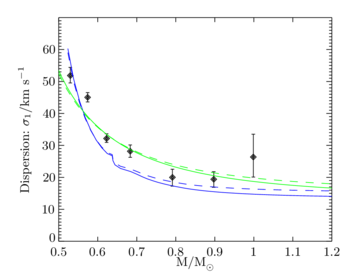
We demonstrated for the first time that there is a clear relationship between the mass of galactic white dwarfs and their kinematics, and used this to show that the majority of high mass (> 1 M ⊙) white dwarfs can be explained though single star evolution, as opposed to binary mergers as had been previously suggested.
Photometric Identification of Ultracool White Dwarfs
Authors: Chris Wegg and Sterl Phinney
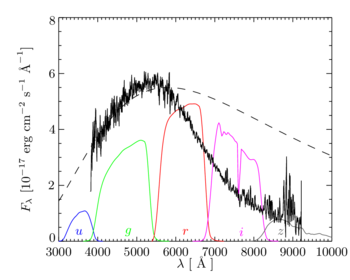
We showed that the coldest, oldest white dwarfs can be identified purely through their colors. We obtained two nights of observing time on the Palomar Hale 4-meter telescope to verify the method and as a result have almost doubled the known sample of ultracool white dwarfs.
See chapter 3 of my thesis:
Analytic Solution to the Fokker-Planck Equation in the Singular Isothermal Sphere
Authors: Chris Wegg and Sterl Phinney
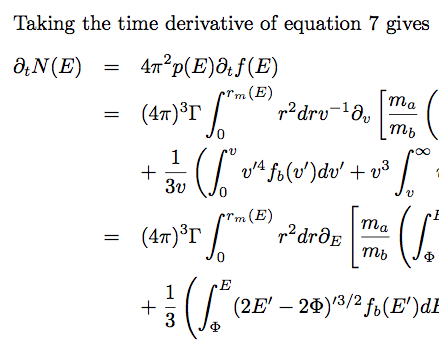
We have derived an analytic solution to the problem of a class of stars evolving dynamically in a background of the singular isothermal sphere using the Fokker-Planck equation. There are very few known analytic solutions to the Fokker-Planck equation, and the solution can potentially be used to help check and calibrate N-body codes, and explain the radial distribution of blue stragglers in clusters.
See chapter 7 of my thesis:
Contact Info
Office Phone:+33 4 92 00 30 26
Address:
Observatoire de la Côte d’Azur
Boulevard de l’Observatoire
F 06304 NICE Cedex 4
E-mail: chriswegg@gmail.com
Follow Me
Site Links
About
 I'm currently a Marie Curie Fellow at the Observatoire de la Côte d’Azur (OCA).